Data Science meets conservation: Helping Tsavo Trust protect Kenya's largest wildlife landscape
.webp)
10+ years
of field data consolidated into a single Power BI analytical layer
33 km
HEC fence impact quantified through interactive dashboards
100%
pro bono delivery through the Visium4Good programme
At Visium, our mission is to democratize AI for the benefit of society and business alike. We master the integration of cutting-edge AI, machine learning, data science, and BI tools that help organisations make data-driven decisions. Power BI is one of the platforms we deploy to put that vision into practice, giving organisations the opportunity to turn well-structured data into decision-grade insight through scalable, business-ready reporting.
That same ambition extends beyond enterprise work. Through Visium4Good, our dedicated social impact programme, we commit time, expertise, and funding to causes that create measurable positive change. Visium4Good supports hackathons, open-source contributions, and long-term collaborations with mission-driven organisations that want to make a difference, using AI to build a better and fairer world.
The partnership with Tsavo Trust is a direct expression of that commitment: applying enterprise-grade Power BI analytics to one of the most complex operational environments imaginable, the protection of Kenya's largest wildlife landscape.
The client: Tsavo Trust
Tsavo Trust is an action-oriented, field-based Kenyan not-for-profit conservation organisation dedicated to securing and protecting the Tsavo Conservation Area (TCA). It operates at the landscape scale, with a long-term mandate to safeguard Kenya's largest formal wildlife protected area.
The organisation occupies a rare position in the conservation ecosystem. It is one of the few partners working simultaneously alongside the Kenya Wildlife Service (KWS) at the full scale of the TCA and directly with surrounding communities to integrate them into conservation outcomes. Its work spans aerial surveillance, ground patrols, human-elephant conflict (HEC) mitigation, and the development of community conservancies.
The problem: a decade of data, underused
By 2023, Tsavo Trust had generated more than ten years of operational and ecological data across aerial patrols, ground monitoring, HEC incidents, transect counts, and community programmes. During the design of its first Strategic Plan (2023–2027), the leadership team identified a critical gap: the data existed, but it was not being systematically analysed to demonstrate impact or guide decision-making.
The operational reality behind this gap was familiar to anyone working in large, remote conservation landscapes:
- Data was fragmented across programmes, collection tools, and time periods
- Reporting was largely manual, limiting the speed and consistency of insight generation
- Evidence of intervention effectiveness, particularly around HEC mitigation, was difficult to produce at the level donors, partners, and field teams required
- The Monitoring, Evaluation and Learning (MEL) function was still being formalised, with a newly established MEL framework and a dedicated M&E Officer in place
Tsavo Trust needed a way to turn a decade of hard-won field data into clear, operational intelligence, without adding heavy tooling overhead to a small team operating in a complex conservation environment.
How we helped: A Power BI analytics layer built around field realities
Visium4Good engaged with Tsavo Trust in early 2026 through a strategic, pro bono partnership focused on analytics enablement rather than one-off deliverables. Three Visium practitioners worked with the Tsavo Trust team in weekly engagements, combining technical implementation with direct capacity building.
The approach was structured around three workstreams:
1. Scoping and data architecture
Through a series of planning sessions, the team mapped Tsavo Trust's existing data sources, identified the highest-value analytical questions, and defined the requirements for an internal data system aligned with the MEL framework. The goal was to design a Power BI environment that could organise, visualise, and analyse existing data in ways that support real-world conservation decisions.
2. Analytical use cases delivered on Microsoft Power BI
Visium selected Microsoft Power BI as the delivery platform for its accessibility, low total cost of ownership, and fit with the Tsavo Trust team's operating model. Two priority Power BI use cases were built end-to-end:
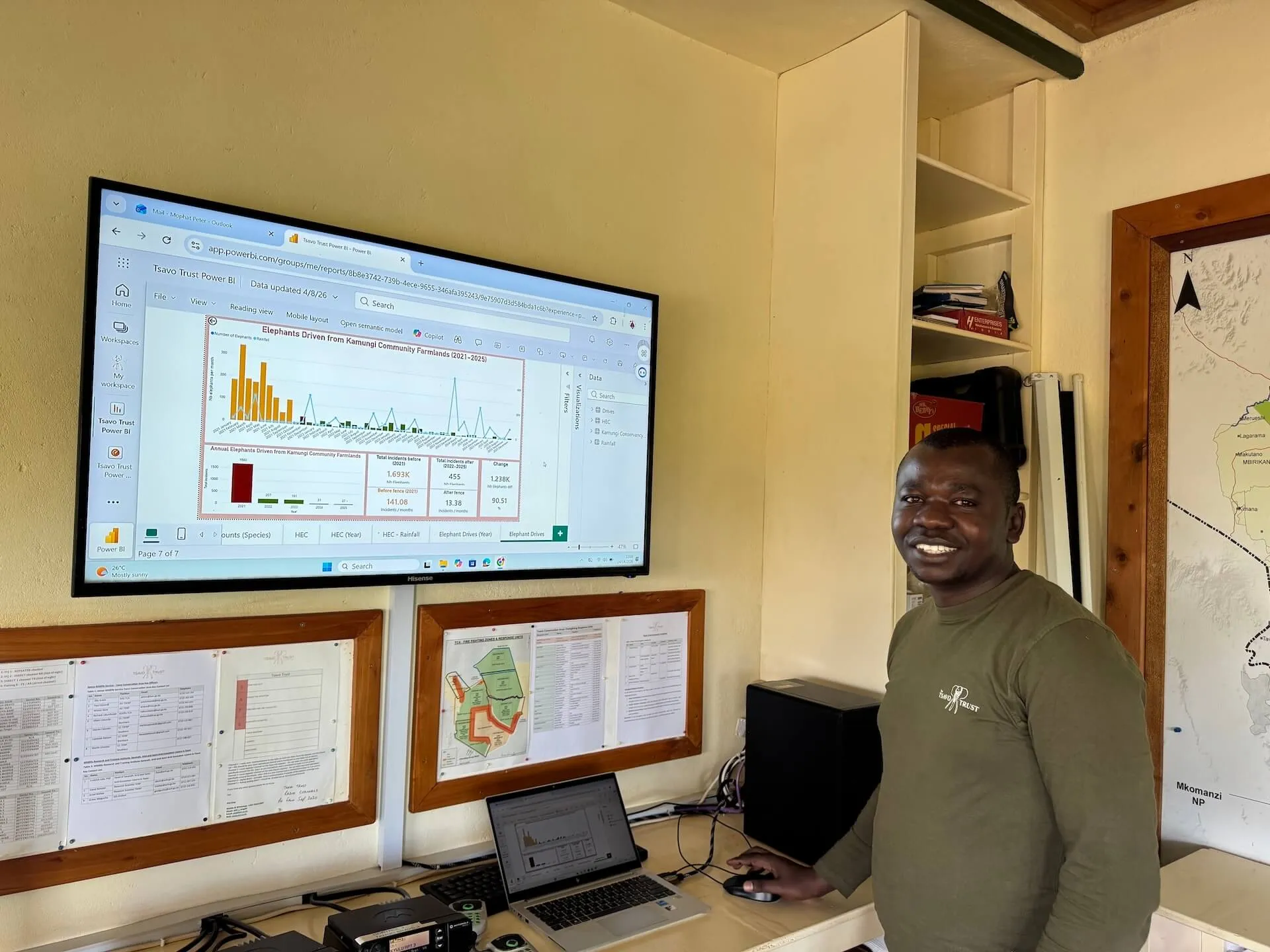
- In-depth analysis and visualisation of Human-Elephant Conflict data in Kamungi Conservancy, including the measured effect of the 33 km HEC mitigation fence on conflict incidence over time
- Transect count analysis for Kamungi Conservancy, surfacing multi-year trends in wildlife recovery
- MEL (Monitoring, Evaluation & Learning) dashboard for Tsavo Trust, unifying programme KPIs such as % reduction in human-elephant conflict into a single view for easier interpretation and decision-making
3. Power BI training and technical mentorship
Rather than delivering dashboards in isolation, Visium embedded Power BI training throughout the engagement. The M&E team and programme leads received ongoing technical support to build, extend, and maintain analytical assets independently, ensuring long-term sustainability of the solution.
The impact
From raw data to decision-grade insight
Tsavo Trust can now translate over a decade of field data into clear, visual evidence of programme performance through Power BI. HEC mitigation measures, including the 33 km Kamungi fence, can be evaluated quantitatively, showing where interventions are reducing conflict and where adaptive responses are needed.
Strengthened MEL operating model
The Power BI layer directly supports the Tsavo Trust MEL Plan (2025–2027), reinforcing tracking of programme performance, impact measurement, adaptive management, and accountability to partners. Internal coordination and reporting consistency have improved materially.
Sustainable internal Power BI capability
Through weekly mentorship, the M&E team and programme leads have moved from ad-hoc reporting to self-sufficient Power BI practice, with the skills required to build new dashboards as priorities evolve.
Sharper external reporting
Tsavo Trust can now provide clearer, more consistent evidence to KWS, the Wildlife Research and Training Institute (WRTI), donors, and community partners, strengthening the case for continued investment in landscape-scale conservation.
"We are incredibly grateful to Visium for their commitment, professionalism, and generosity. Their support has been practical, hands-on, and deeply aligned with the realities of conservation work on the ground. By dedicating time, expertise, and resources, entirely on a pro bono basis, they have helped Tsavo Trust unlock the value of its own data. This has strengthened our systems, and our ability to deliver effective conservation outcomes across the Tsavo landscape." Mophat Peter @ Tsavo Trust
Looking ahead
With the Power BI foundation now in place, Tsavo Trust is better positioned to continue advancing its Monitoring, Evaluation and Learning journey across four areas:
- Continuous improvement of monitoring and evaluation, refining how programme performance is tracked and assessed over time
- Stronger internal coordination across teams, linking data, reporting, and decision-making more tightly across the organisation
- Clearer, more consistent reporting to partners and supporters, translating field activity into evidence that resonates with donors, KWS, WRTI, and community stakeholders
- Evidence-led conservation across the TCA, ensuring that efforts throughout the Tsavo Conservation Area are guided by data, experience, and ongoing learning
For Visium, the engagement reinforces a core conviction behind Visium4Good: the same analytical rigour that drives value in pharma, speciality chemicals, and other regulated industries can translate directly into conservation outcomes when it is grounded in field realities and delivered with genuine partnership.
%20(1).webp)
%20(1).webp)
.png)