Speed to market in flavor development: Why the delay sits between companies

Table of Contents
New flavor and ingredient products still take years to reach the shelf. Most of that time is lost in the handovers between raw material makers, ingredient houses, and brands.
The only question left is how fast
Every ingredient in the matcha drink I buy today existed years before the bottle did. Protein, collagen, matcha, zero sugar: none of it was new, yet it took the better part of a decade to reach me. I already know what I want in the next version: fiber, and I know it will take too long.
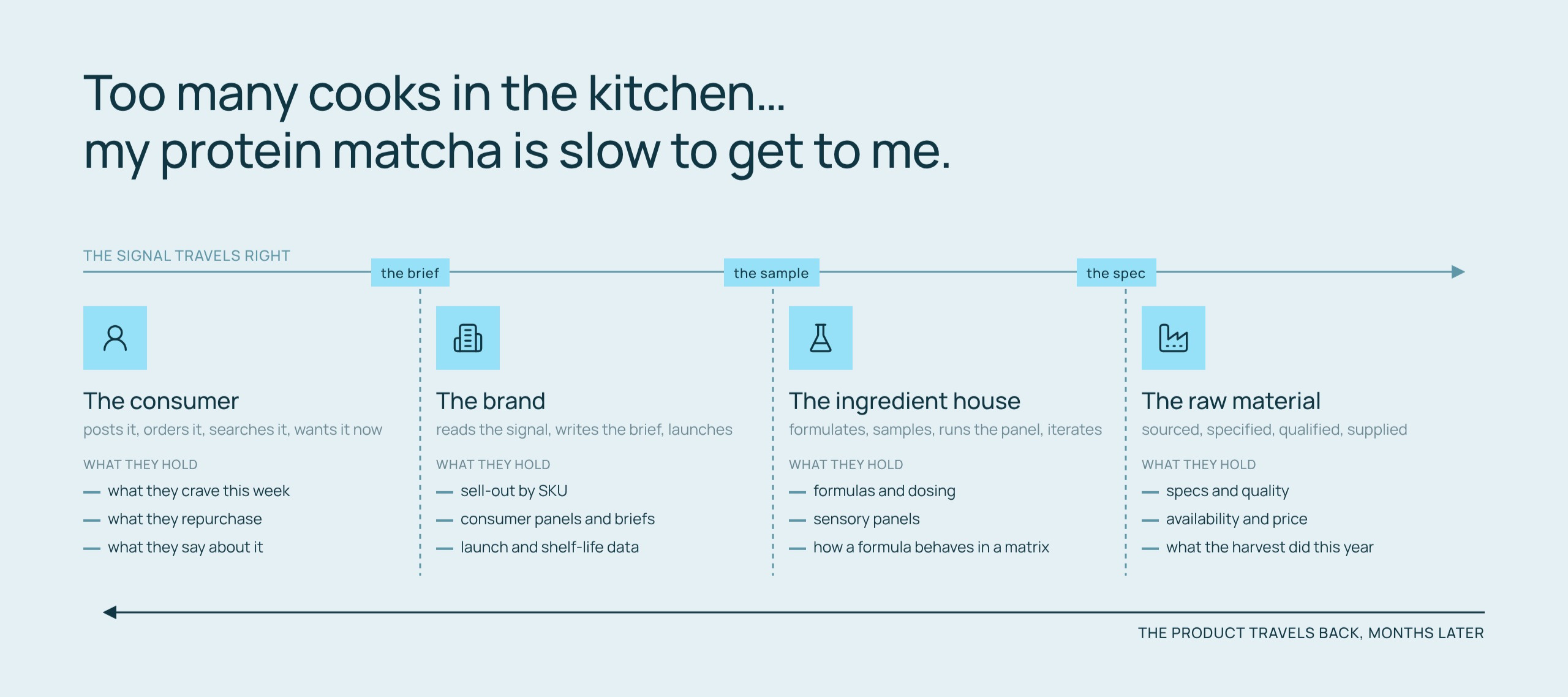
That gap is the speed-to-market problem in flavor and ingredient development, and it was my point on stage at MISTA in San Francisco a few days ago. As an industry, we have largely answered two questions: what do we want to make, and how do we make it. The question we still avoid is how fast a consumer signal can travel from the brand to the ingredient house to the raw material, and back to the shelf.
Personalized food and beverage demand makes speed the business model
Customization is a flywheel, and it will not wait.
On the same trip, I roamed the aisles of a few US supermarkets to see for myself how the flavors and ingredients I work with all year land on a consumer's shelf. What hits you first is the number of options. Healthy and unhealthy side by side, the unhealthy usually cheaper, and above all an enormous amount of choice.
That shelf led me into conversations at MISTA about individual customization, and it changed how I see the speed problem. Those options exist because consumers asked for them, and the next one is already here: my drink, my protein, my flavor, my dose. Demand for a product made for one person creates a new supply. The new supply teaches consumers to expect more of it, and that expectation creates the next demand. It is a flywheel, each turn feeding the next, and it is building a new market as it spins. A market like that rewards one thing above all: the chain that can turn a consumer signal into a product before the signal moves on. How fast stops being an efficiency question and becomes the business model.
Faster development is how healthier products reach the shelf first
The flywheel has a cost, and it sits on the consumer side. A flywheel does not care which way it spins. Whatever you want, whenever you want, however you want is a promise that works just as well for the unhealthy shelf as for the healthy one, and so far it has worked better there. Producers carry a share of the responsibility for that, and most of them know it. The same week, at Stanford's 10th annual Food Day, clinicians from the School of Medicine made the case from the other end: the healthier choice has to be on the shelf, and people have to be able to pick it. More whole foods, less of what the cheap end of the aisle sells.
Everyone I spoke to that week agreed on that much. Where it fell apart was ownership. Somebody has to teach the consumer to want the better product, and nobody could tell me who. The producer? The retailer? The doctor? A regulator, a school, a brand? My answer is the private actors in this industry, and speed is how they get there. Today a consumer signal takes years to reach the raw material. Shorten that to weeks and the whole chain gains an efficiency it has never had, and that efficiency can be spent on products that reach the shelf faster and are healthier and cheaper when they get there. The private side of this industry can bring the better option to the table, and bring it first. That is the real prize.
The flywheel is already spinning. What matters now is who shapes it, and that will be whoever moves first.
Why flavor development is slow: trust and data gaps across the ingredient chain
There is no culprit in this story, and anyone who has spent time inside the chain knows it. The raw material makers, the ingredient houses, the brands, the labs: each of them is an island of deep knowledge, each works hard, and each is slow for reasons that make sense from where it sits. Nobody is doing anything wrong, which is why nothing gets faster.
What we are attempting is hard. We are trying to turn a string of islands, each one a separate company, into one connected ecosystem, from the raw material to the ingredient to the brand to the person holding the bottle. That asks companies that spent decades protecting their formulas, their consumer data and their margins to share parts of them with partners they do not fully trust. A brand hesitates to open its consumer signal to a company it has always treated as a supplier. An ingredient house hesitates to show its formulation knowledge to a customer who also talks to its competitors. Both hesitations are rational. Both cost time, and the product waits.
Data makes it worse. Even where the trust exists, most organizations in this industry could not share much if they wanted to. Formulation history sits in spreadsheets and in the heads of people close to retirement. Teams run sensory panels and file them away. Consumer insight reaches the formulator as a slide deck. Those are the bridges between the islands today: a brief, a deck, a sample in a courier box. Rope bridges, for a market that is starting to move at highway speed. Data maturity is low across the chain, and you cannot connect what you cannot find.
The slowness comes from a thousand reasonable decisions made by people who do not share a table, and no single company can fix that on its own, however good its intentions or its tools. I saw the missing table at Stanford's Food Day: a full day of clinicians talking about food as health, and almost nobody from the companies that decide what goes into the bottle. I was one of the few people there from the business side.
Who moves first: building shared loops between brands, ingredient houses and suppliers
Consensus will never be fast, so I am writing this to find people. Somewhere in a raw material company, an ingredient house, a brand, a retailer, a university lab or a startup, some people look at the distance between the consumer and the molecule and are as impatient as I am. People willing to share a dataset before the legal review is perfect. People willing to run a sample before the brief is signed off. People willing to build a loop with a partner instead of a handover, and to take a real risk to prove that the time between a signal and a sample can be weeks instead of years. And people willing to own the part nobody owns today: putting the better product in front of the consumer before the worse one gets there. Change in this industry starts with a handful of them deciding to move first, together, and showing everyone else that it works.
I still want the fiber in my matcha. Eight years was long enough for one bottle. The next one should not take eight more.
If you are one of those people, wherever you sit in the chain, come and find me. I would rather take the risk with you now than wait another decade for the next bottle.