What is AI Agent orchestration and why it should matter to you

جدول المحتويات
As organisations scale the use of LLMs in real AI-powered workflows, an important architectural question starts showing up around how intelligent agents should be structured to handle complex tasks reliably.
This is the gap AI agent orchestration is designed to close.
With increasing workflow complexity comes a greater need for coordination between agents, clear role specialisation, and human oversight when issues arise. Orchestration is what separates a proof of concept from a system you can actually trust.
Understanding AI agent orchestration is key to moving from isolated AI experiments to scalable, production-grade systems.
What is AI agent orchestration?
AI agent orchestration is the process of coordinating multiple agents to work together toward a shared goal. Rather than relying on a single, general-purpose AI solution, AI agent orchestration employs a network of AI agents, each designed for specific tasks, working together to automate complex workflows and processes.
In production environments, agents rarely operate alone. Instead, they function in structured groups, where each one has clearly defined responsibilities, access to specific tools, and a controlled information flow. Orchestration is the layer that defines how those agents interact – what each one is accountable for, what tasks they should handle, what they are specialised in, and how information moves between them.
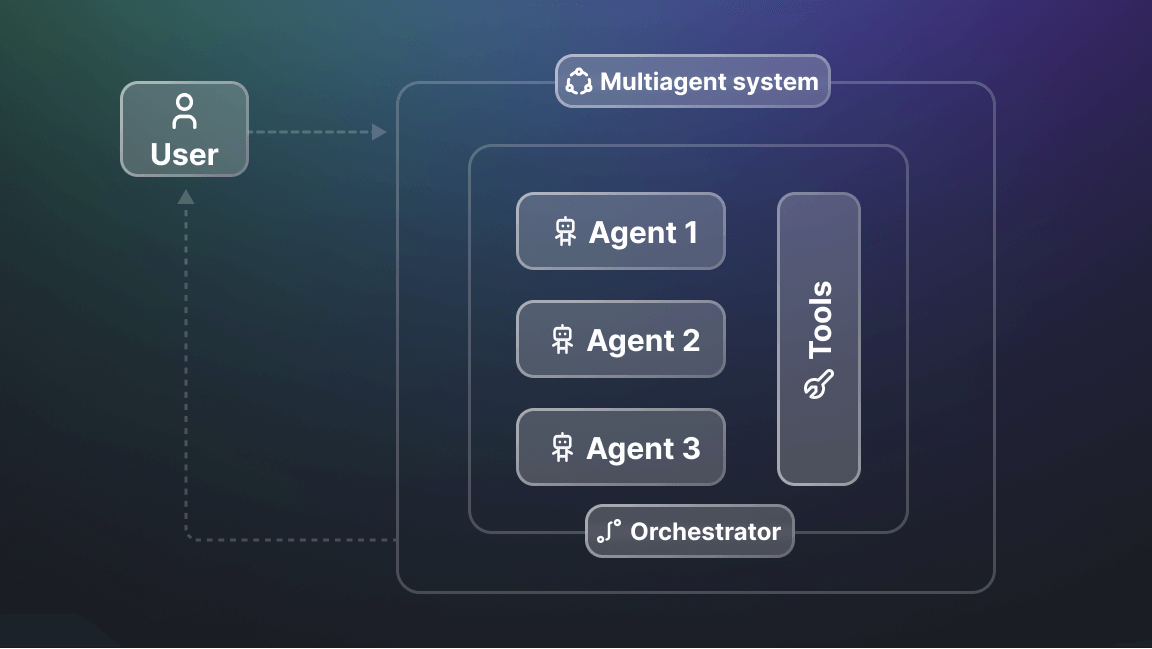
This structured coordination is what enables multi-agent systems to address complexity without amplifying risk.
Why not just build one “super agent” that can do it all?
This is usually one of the first questions that comes up when teams begin exploring agentic AI, and the answer to it is complexity.
As tasks scale, so do the requirements placed on the system. An agent may need access to different knowledge bases, multiple external tools, domain-specific constraints, and structured reasoning steps. When a single agent is given dozens of tools and multiple responsibilities, the system does not simply become more capable, but rather, it becomes more fragile.
This is not a new problem in software design. Systems that centralize too much responsibility in a single unit consistently become harder to scale, harder to debug, and harder to trust.
Multi-agent architectures address this directly. They break complexity into specialized components, each with a clear scope.
A practical example: Clinical document drafting
The value of orchestration becomes particularly evident in regulated industries such as Life Sciences, where workflows are inherently complex, and compliance requirements are strict.
Clinical document drafting, involves synthesising large volumes of source material, executing statistical analysis plans, generating structured outputs, and ensuring adherence to evolving regulatory standards. Traditionally, this process requires coordinated input from multiple domain experts to produce documentation that is accurate, auditable, and submission-ready.
When applying agentic AI to this workflow, a single general-purpose agent would struggle to maintain reliability across all dimensions. Instead, a specialised multi-agent architecture proves far more effective.
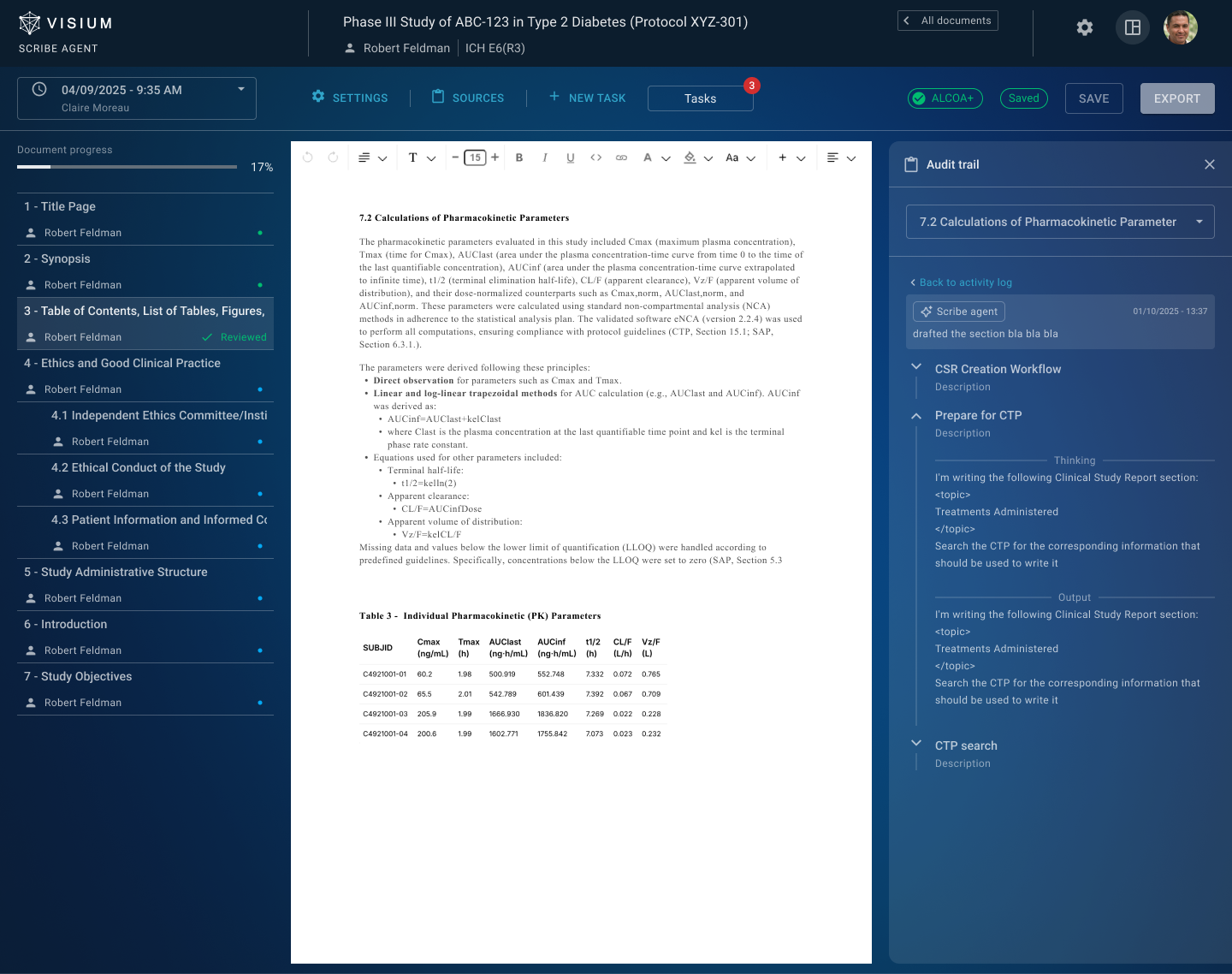
Information extraction agents focus exclusively on reviewing source documents and identifying relevant content for inclusion in the draft. Analysis agents execute statistical plans, generate code, and produce tables that populate results sections. Compliance agents review the assembled document against current regulatory guidelines, ensuring that formatting, language, and structure align with submission requirements.
Orchestration governs how these agents interact. It defines how extracted information becomes structured input for analysis, how analytical outputs are integrated into narrative sections, and how compliance validation is triggered before finalisation. This layered coordination ensures functional automation, traceability, and quality assurance throughout the workflow.
The outcome is a system that delivers documents that are reliable, auditable, and ready for regulatory review, reducing time to first draft to under 10 minutes and cutting authoring time by 30–70%.
Orchestration as a foundation for production-grade AI
Ultimately, AI agent orchestration is less about technical innovation and more about operational maturity, reflecting the shift toward structured, production-ready AI systems.
Production-grade agentic systems require clear role definitions, explicit information flows, controlled tool access, logging mechanisms, and evaluation checkpoints. They require separation of concerns and governance by design. Orchestration provides the framework through which these requirements can be met. With it, agentic AI becomes a reliable infrastructure capable of supporting high-stakes decision-making and regulated workflows.